
Jefferson County Release Date Types
A pretrial detainee usually has no fixed release date. Bond may be set or a hearing may be pending, but physical departure still depends on payment or approval, processing, and any other hold. A person serving a county sentence has a court judgment and local jail-credit computation. A TDCJ prisoner may have several labeled dates, each with a different meaning.
The TDCJ definitions identify Projected Release Date as a calculation by Classification and Records for when confinement is expected to end if parole does not occur sooner. Parole Eligibility Date is only the point when consideration may become possible. Maximum Sentence Date is the calculated sentence endpoint. Scheduled Release Date and Scheduled Release Location, when posted during processing, are more operational but can still change.
| Date or status | What it means | What it does not prove |
|---|---|---|
| Bond or court setting | A legal or financial step in a county case | Completed checkout from jail |
| Parole eligibility | Possible consideration under the governing statute | Approval or release |
| Projected release | TDCJ calculation under applicable release rules | Actual departure time |
| Scheduled release | Operational date after more processing | A date immune from change |
| Actual release or discharge | An accomplished custody event or final TDCJ status | Freedom from every other hold |
Search Jefferson County Release Dates
Start by identifying the custodian. The Jefferson County live inmate search covers county jail custody, while TDCJ Offender Search covers people committed to Texas prison or state jail. The BOP locator covers federal imprisonment. Beaumont alone is not enough because Jefferson County contains county, state, and federal facilities.
- Confirm the facility and obtain a booking, TDCJ, SID, or federal register number when possible.
- For TDCJ, open the official offender search and read the full detail, not just a result row.
- For a county case, check the court judgment or most recent order, then call the Jefferson County jail at 409-726-2500 for the local computation or checkout status.
- Compare the projected, eligibility, maximum, and scheduled fields without treating them as synonyms.
- After the expected day, confirm actual status through the agency record, incarceration history, or a release sheet.
A named-person departure can also be resolved through the broader Jefferson County release-record path. It reconciles the jail ledger with the court order and any receiving agency.
TDCJ Jefferson County Date Fields
The TDCJ search can show identifying information, current status or unit, offense, county and court, sentence, projected release date, parole eligibility date, and maximum sentence date when those fields apply. Identifier searches are stronger than name-only matching. A Jefferson County jail detainee will not appear just because the arrest occurred locally; TDCJ must have received the person or hold a relevant state record.
TDCJ also offers an email information channel for current and previous incarceration history. Its available-information page explains the projected-date field and what can be requested.
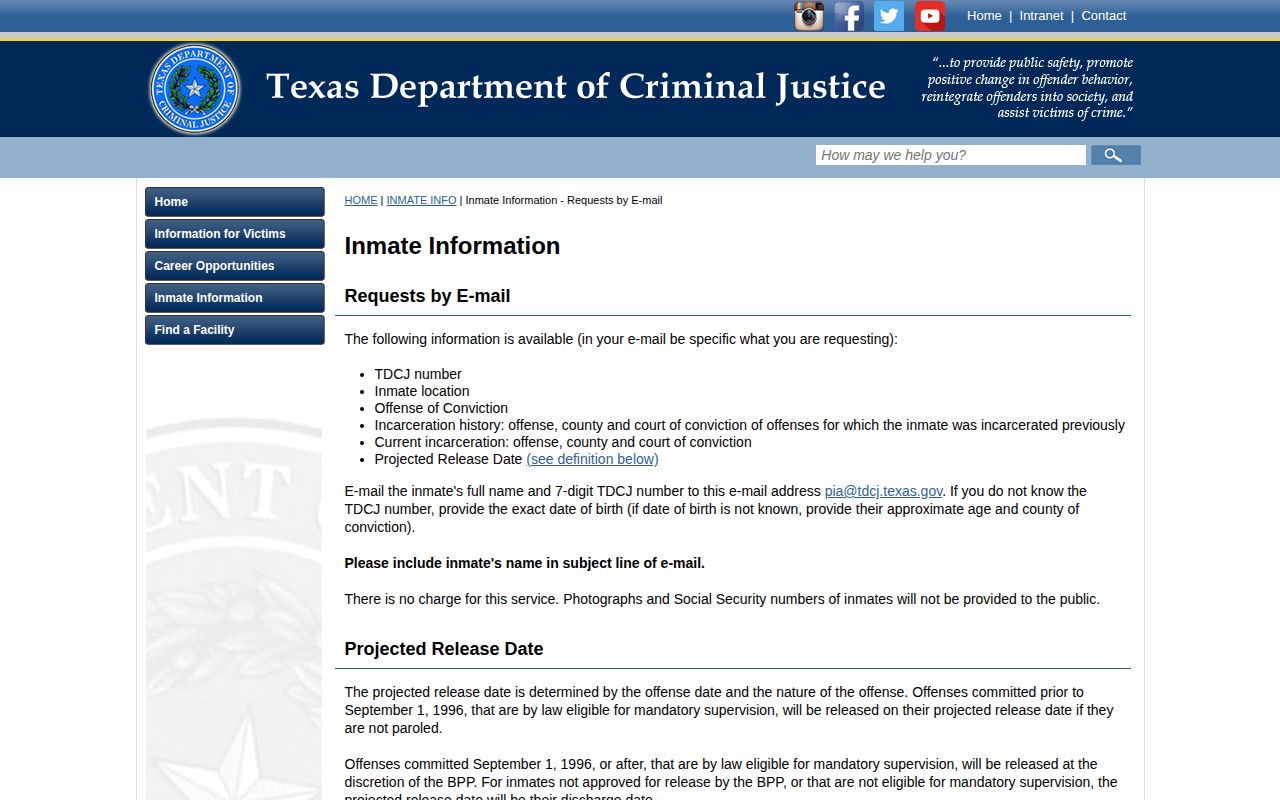
The source supports a historical request when the public detail is incomplete. Put the person’s name in the subject and provide the full name plus seven-digit TDCJ number. If that number is unknown, include exact birth date or approximate age and county of conviction. Ask for the actual release or discharge date and type.
Jefferson County Jail Date Computation
County jail time follows the judgment and local custody record, not TDCJ’s good-conduct class table. Texas Code of Criminal Procedure article 42.03 requires sentence credit for confinement as the law provides. The judgment’s jail-credit entry, Sheriff computation, concurrent or consecutive terms, other causes, and the actual release order can all affect the local date.
A person awaiting trial may leave through bond, dismissal, court order, transfer, or another event, so there may be no sentence-based forecast at all. When a county sentence is being served, ask the jail for the calculated release date and whether another hold is present. Then inspect the Jefferson County docket for the signed judgment and later orders. A docket entry is legal context, not the jail-door timestamp.
Multiple Jefferson County causes require special care. One case may show bond or time served while another has an active commitment. A person can also leave county custody through transfer to TDCJ or another agency rather than return to the community. Ask the jail to identify whether its date is a sentence-end estimate, an expected transfer, or a completed checkout. If the answer cites another custodian, continue with that system and preserve the county booking number and receiving-agency name. The physical event record and the latest signed order should agree before a historic release date is treated as settled.
Note: Never apply a TDCJ credit chart to a Jefferson County jail stay without a state commitment and an agency calculation.
Texas Good Time and Release
Government Code Chapter 498 authorizes TDCJ good-conduct classifications and credits. Good time does not shorten the judicial sentence itself, and it creates no unconditional right to leave prison. Credits may affect a release calculation where the controlling statute allows, and they may be forfeited or restored under agency rules.
Texas also has no universal rule that every prisoner serves 85 percent. Government Code sections 508.145 through 508.149 apply different parole and mandatory-supervision rules according to offense, sentence, and offense date. For certain serious offenses, eligibility commonly requires actual calendar time equal to one-half of the sentence or 30 years, whichever is less, subject to the statute’s exact terms. Eligibility still means consideration, not a release commitment.
- Flat time
- Actual calendar time served in confinement.
- Good-conduct time
- TDCJ credit used only where law permits it in a calculation.
- Parole eligibility
- The date a case may become eligible for review.
- Maximum expiration
- The calculated end of the sentence when no earlier lawful release applies.
Jefferson County Date Changes
Release dates can change for reasons found in different records. Corrected jail credit may alter the time computation. Concurrent or consecutive sentences can be clarified. Disciplinary action may affect good time. A new detainer, pending case, or receiving-agency hold can block community release even after one sentence reaches its date.
| Change factor | Record to check |
|---|---|
| Corrected jail credit | Judgment, court order, and agency calculation |
| Good-time loss or restoration | TDCJ classification record |
| Parole grant or denial | TDCJ detail and BPP decision code |
| Program or address approval | Release processing and parole record |
| Detainer or new case | Custodian, docket, and receiving agency |
| Appeal or sentence correction | Latest signed court order |
TDCJ states that Classification and Records audits and calculates a scheduled date after receiving a release certificate. Even that date may change without notice, including on the expected day. A scheduled release location may name the operational exit point rather than the person’s residence.
When dates conflict, compare when each source was updated and what event it describes. A court order may change the sentence before the public TDCJ detail refreshes. A BPP decision can authorize a later step without setting the final departure time. An IVSS notice can report a custody change after processing, but it does not replace the classification calculation. For a local case, the Sheriff may still need to reconcile credit across more than one cause number. Record the label, source, and update time for each date. Then ask the agency which entry is current and whether the date concerns eligibility, scheduled movement, transfer, or completed release.
Jefferson County Mandatory Supervision
Texas’s projected-date calculation has an important September 1, 1996 dividing line. For eligible earlier offenses, TDCJ explains that projected release may occur when flat time plus good time equals the sentence, absent earlier parole. For eligible offenses on or after that date, reaching the credit point is not sufficient by itself. BPP must approve discretionary mandatory supervision.
If BPP denies mandatory supervision, TDCJ can move the displayed projection to maximum expiration. A later approval may move it earlier for release processing. For offenses legally excluded from mandatory supervision, projected release generally aligns with maximum expiration unless parole occurs first. The BPP mandatory-supervision explanation supplies the governing process, while the offender detail supplies the person-specific date.
This Jefferson County date quirk is why a simple sentence percentage fails. Offense date, legal eligibility, credits, BPP review, and processing all matter. Recheck the exact labels after each decision rather than carrying forward an old screenshot or estimate.
Note: A past projected date without a released or discharged status is a reason to verify, not proof that custody ended.
Public Record Search
Sponsored Results