
Jefferson County Parole or Probation
A person outside the Jefferson County Correctional Facility may be under parole, mandatory supervision, probation, or no supervision at all. Parole and mandatory supervision are state systems. The Texas Board of Pardons and Paroles makes parole decisions, and the Texas Department of Criminal Justice Parole Division manages supervision. Probation, formally called community supervision in Texas, comes from a court order and is administered locally by the Jefferson County Community Supervision and Corrections Department, or CSCD.
The release source points to the right record. Someone leaving Larry Gist State Jail, the LeBlanc Unit, or the Stiles Unit may have a TDCJ status and a Parole Division assignment. Someone sentenced by a Jefferson County court to community supervision should have that disposition in the criminal docket and may report through CSCD. A person released on bond is not on probation merely because conditions apply to the pending case.
| Point | Parole | Probation |
|---|---|---|
| Legal basis | Conditional release from a TDCJ sentence after BPP action | Community sentence ordered by a trial court |
| Local administrator | TDCJ Parole Division and the assigned district office | Jefferson County CSCD |
| Public starting record | TDCJ offender detail, IVSS, and BPP decision information | Felony or misdemeanor court docket |
| End of supervision | TDCJ discharge or other final status | Court termination, completion, or discharge record |
Check Jefferson County Supervision Records
Verification works best when the state and local records are not blended. The TDCJ Offender Search accepts a TDCJ number, State Identification number, or personal details. Its result may show status, unit, projected release date, parole eligibility, and review information. Those forward-looking dates do not prove physical release. For probation, the court record establishes whether community supervision was imposed, later modified, revoked, or ended.
- Identify whether the sentence came from a Jefferson County court or TDCJ confinement.
- For a state case, open the TDCJ detail and record the exact status, identifiers, and parole fields.
- For probation, locate the felony case in the District Clerk criminal index or obtain a Class A or B misdemeanor record from the County Clerk.
- Use the official office directory only after the record indicates supervision. Provide the TDCJ, SID, or cause number when disclosure is allowed.
- Ask for the precise status, such as active supervision or discharge. Do not infer it from a missing jail entry.
The underlying release event can be checked through the full Jefferson County released inmate search and records path. That path separates release to the community from a transfer to TDCJ, another county, a federal agency, or another custodian.
Jefferson County Parole Decision Status
Texas parole review is chiefly a file-review and voting process. It is not a public calendar of routine inmate interviews. TDCJ Classification and Records calculates eligibility dates, institutional parole staff prepare the file, and a BPP panel votes. Eligibility means the case may be considered. It is not a release promise. A favorable decision may still depend on programs, a release plan, an approved address, processing, and the absence of other holds.
The BPP review process explains the stages and decision codes. The official view shown below helps place a short code in its procedural context.
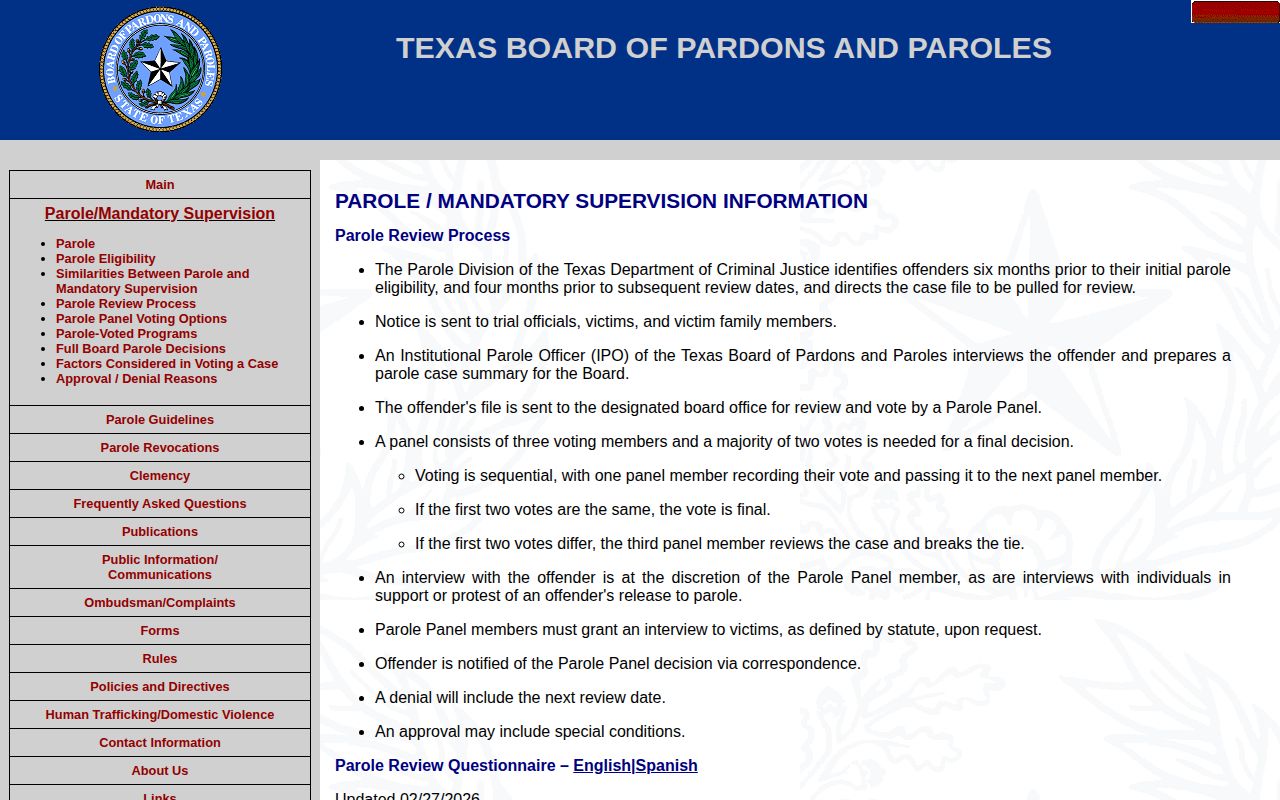
A denial may include a later review date or a serve-all instruction. An approval is not the same as an accomplished release. Recheck the TDCJ record for scheduled information and then the current status after the expected date.
Government Code Chapter 508 governs parole eligibility, mandatory supervision, warrants, and discharge. The controlling subsection depends on the offense, sentence, and offense date, so a universal percentage should not be used. The person-specific TDCJ fields and the exact BPP code are safer than a rough calculation.
Jefferson County Supervision Offices
Jefferson County probation has two published access points. The Beaumont office is the main CSCD location, while Port Arthur is a satellite. The department describes Intake as handling felony and misdemeanor cases plus transfers into Jefferson County. Its Transfer Out function monitors cases assigned to another jurisdiction. This matters because the sentencing court and the office that now supervises the person may be in different counties.
820 Neches
Beaumont, TX 77701
409-951-2200
Fax: 409-951-2293
800 4th Street
Port Arthur, TX 77640
409-983-8360
Fax: 409-983-8341
The CSCD contact page is the source for both locations. Staff may confirm routing or explain office procedure, but unrelated callers should not expect confidential case-management details.
Parole uses a separate state directory. The TDCJ Region I office list contains the Beaumont District Parole Office and should be checked for its current listing before contact.
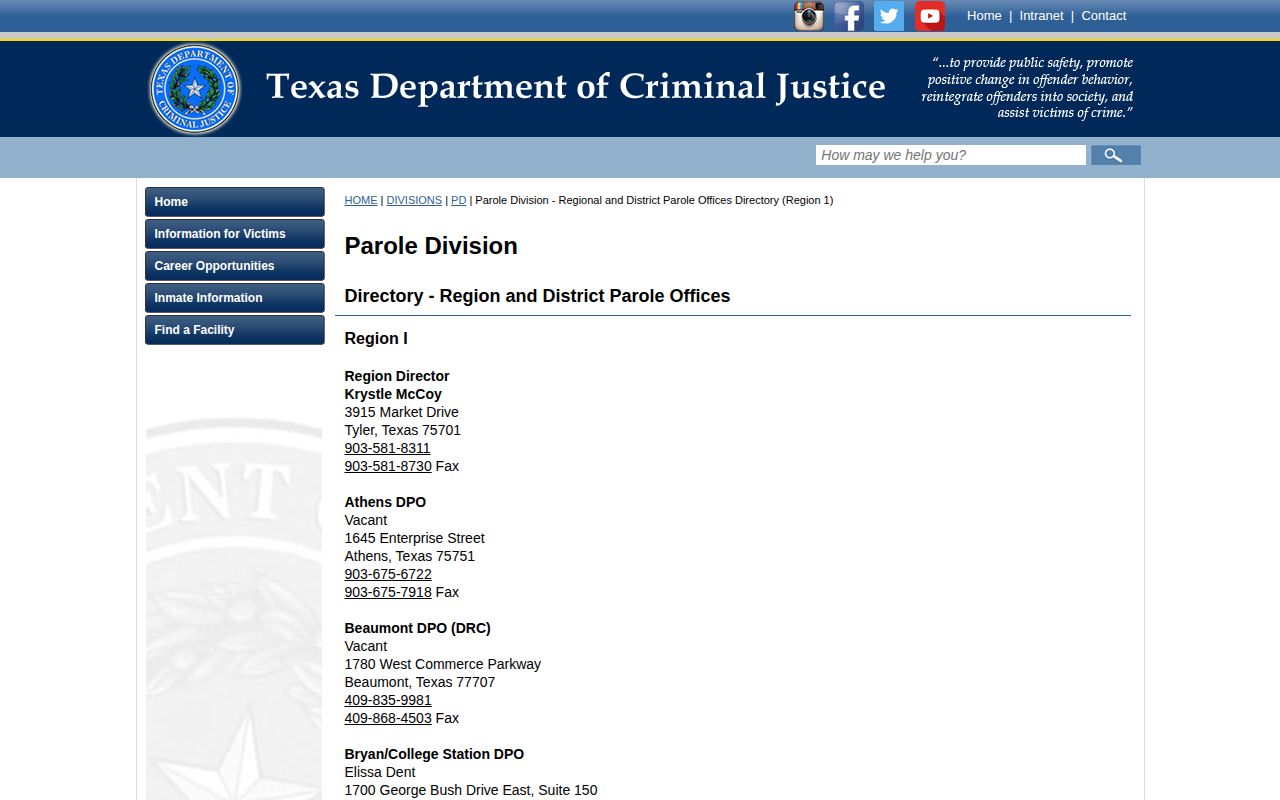
The directory image confirms the local state-parole entry. It does not show that a named person is assigned there, so pair it with the TDCJ record.
Note: Office assignment can follow the approved residence or a transfer, not the county where the original sentence was entered.
Jefferson County Supervision Terms
Several terms describe different points in the process. Their distinction prevents a release alert or court entry from being overstated.
- Parole
- Conditional release from prison under TDCJ Parole Division supervision after an authorized BPP decision.
- Probation
- A court-ordered community sentence, called community supervision in Texas, managed locally by CSCD.
- Mandatory supervision
- A statutory state-release process that may require BPP review and approval, depending on the offense date and eligibility rules.
- Absconder
- A person alleged to have stopped reporting or left supervision without authorization.
- Discharge
- The formal end of the sentence or supervision obligation administered by the agency.
Conditions vary by order and case. They can include reporting, approved residence, travel limits, treatment or programs, fees, and compliance with the law. The signed probation order, parole certificate, and later modification records control. A short public status cannot replace those documents.
Jefferson County Violation Records
An alleged violation occurs after release and does not erase the earlier release event. On probation, a motion to revoke or motion to adjudicate and a capias may appear in the Jefferson County court docket. A capias is a court order directing arrest. The docket may show filing and hearing activity, but the signed order determines whether supervision was revoked, continued, or changed.
On parole, use the TDCJ and BPP status route. Some operational warrant information is not public. The state also maintains a Sex Offender Absconder Information Search for the narrow group covered by that system, but absence from that list says nothing about most people on parole or probation. Never treat an absconder label as proof that the person stayed in custody continuously.
TDCJ IVSS can provide information and notifications for people in TDCJ custody or on parole or mandatory supervision. Jefferson County probation is outside that state lane. A status alert is useful for timing, yet the agency or court record remains the stronger source for the legal result.
Jefferson County Supervision Discharge
Supervision ends through a formal event, not merely because an online result disappears. A TDCJ discharge generally means the sentence or obligation managed by TDCJ has ended. Parole or mandatory supervision means the person is outside confinement with a part of the sentence still active. Read the displayed status exactly and request incarceration or release history from TDCJ when the public detail does not resolve the date.
Probation completion should be tied to the Jefferson County court record. Look for an order terminating community supervision, an order discharging the person, or another final disposition. Early termination, revocation, and routine expiration are not interchangeable. The CSCD office manages supervision, while the court record establishes the judicial action.
For a durable state history, TDCJ directs requests to its offender information email channel. Include the full name and seven-digit TDCJ number when known, or exact birth date or approximate age and county of conviction. Ask for the actual release or discharge date and type, not only a projected date.
Note: A notification, parole vote, scheduled date, physical release, and final discharge are five distinct events in a Jefferson County state case.
Public Record Search
Sponsored Results