
Larry Gist State Jail Departures
Larry Gist State Jail, unit code BJ, is operated by TDCJ. It is not a Jefferson County jail even though its address is in Beaumont. A man may leave Gist by discharge of the state-jail term, movement to another TDCJ placement, or another lawful custody event. Supervision may apply only when the governing sentence and law provide for it. Do not import parole assumptions from a prison sentence into a state-jail sentence.
The TDCJ record is authoritative for the state custody segment. County arrest records may show how the original prosecution began, but they do not prove when a state term ended. A county current roster is also irrelevant unless a later county booking occurred. First identify the TDCJ number, State Identification number, or SID, and county of conviction. Those details reduce same-name errors.
Confirm a Larry Gist Discharge
Open the TDCJ Offender Search. Search by the seven-digit TDCJ number or SID when known. Otherwise use name, sex, race, and approximate age to narrow the result. Open the full detail and read the location, status, offense, county, sentence, projected release, parole eligibility, maximum sentence, and any scheduled release fields according to their exact labels.
- Match the person with an identifier and conviction details.
- Check whether the listed location is Gist, another TDCJ unit, or a release status.
- Record each date label rather than copying a date without context.
- Use TDCJ IVSS when the person is in state custody or on state supervision.
- Request incarceration history when the live detail cannot prove the past event.
A Projected Release Date is an estimate calculated by TDCJ Classification and Records. It is not evidence that the person left on that date. A Scheduled Release Date and Location may appear after processing, but can still change. An actual historical departure is better shown by status, incarceration history, or a TDCJ release or discharge record.
Larry Gist Release Date Labels
TDCJ uses several date fields that answer different questions. Parole Eligibility Date marks when parole consideration may become possible under controlling law. It does not promise a vote or release. Projected Release Date is an anticipated end of confinement under the calculation that applies. Maximum Sentence Date is the sentence endpoint as calculated in the record. Scheduled Release Date and Location are operational fields that may post after release work advances.
A discharge generally means the sentence or obligation administered by TDCJ has ended. Parole or mandatory supervision means confinement ended while a state supervision term remained.
State-jail sentences have their own statutory features. Texas Government Code Chapters 498 and 508 should not be compressed into a universal percentage rule. Offense, sentence type, controlling dates, time calculations, exclusions, holds, and court action can change the result. If a date has passed while status remains unclear, request the accomplished event rather than presuming discharge.
Larry Gist Records and Contact
TDCJ’s unit directory supplies the official facility address and telephone. The unit can route immediate facility questions, but statewide Classification and Records maintains offender history. Use the general inmate-information channel for prior incarceration and release facts. For an existing document or certified copy, follow the TDCJ Public Information Act process.
Larry Gist State Jail (BJ)
3295 FM 3514
Beaumont, TX 77705
409-727-8400
Operator: Texas Department of Criminal Justice
The TDCJ inmate information page directs requests to pia@tdcj.texas.gov. Put the person’s name in the subject. Supply full name and TDCJ number; if the number is unknown, provide exact birth date or approximate age and county of conviction. Ask for current and previous incarceration history plus the actual release or discharge date and type. TDCJ describes this information service as free, but says photographs and Social Security numbers are not provided through that email channel.
Read Larry Gist Search Results
A useful match aligns more than a name. Compare TDCJ number, SID when available, age or birth date, county and court, offense, sentence, and dates. If identifiers conflict, do not merge the histories. Ask TDCJ for help identifying the correct record. A photograph alone is weak evidence and should not override inconsistent numbers or case facts.
The official search form is shown below through its TDCJ source. Its statewide scope is the reason it can follow a person who transfers away from Gist, while the Jefferson County jail search cannot.
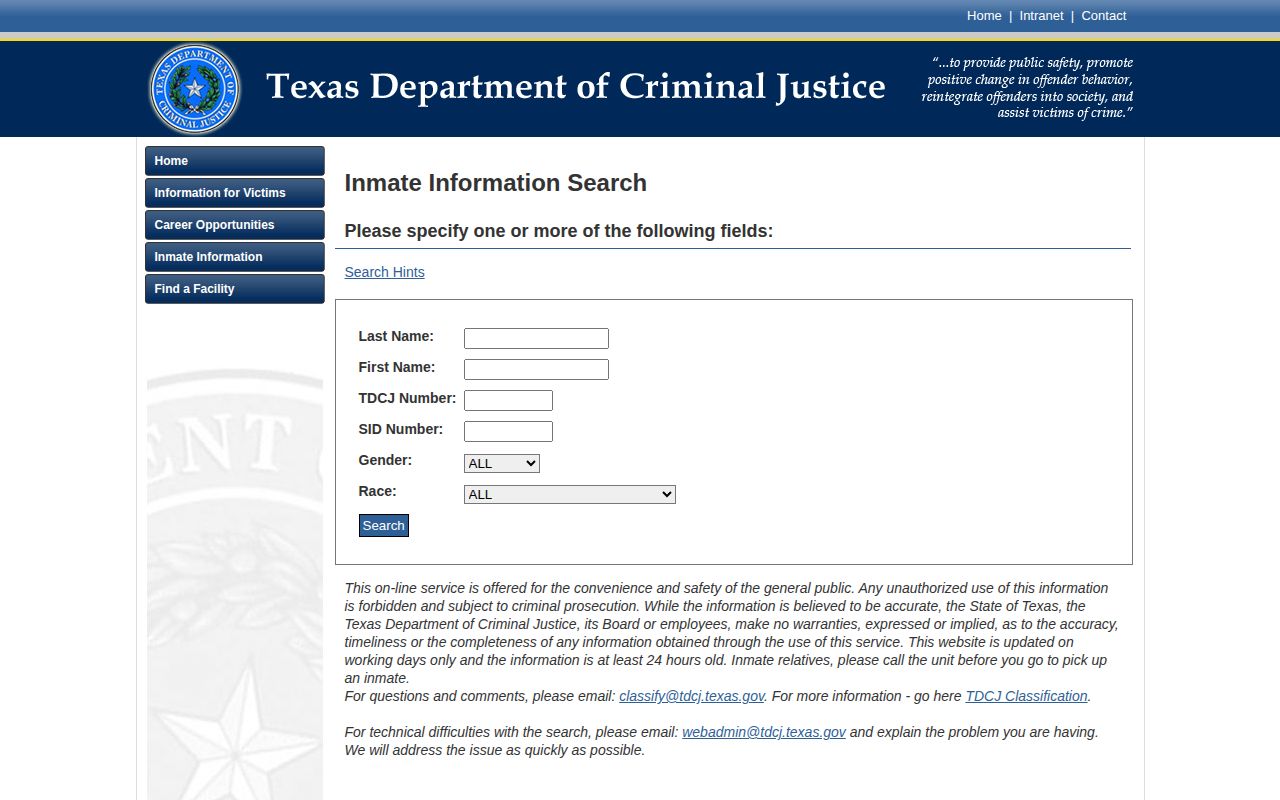
If the current detail shows another unit, the person has left Gist but remains in TDCJ custody. If it indicates parole or mandatory supervision, use TDCJ IVSS and the Parole Division to confirm state supervision. If it shows discharge, incarceration history can provide a more lasting account of the completed term.
Beaumont State Release Cluster
Gist sits in a distinctive group of three TDCJ units along FM 3514. Richard P. LeBlanc Unit is a pre-release facility. Mark W. Stiles Unit holds several male custody levels. The nearby institutions share the Beaumont label, but assignment to one unit does not establish a planned discharge from another. Always read the current TDCJ location and unit code.
The same county also contains the JCSO correctional facility and FCC Beaumont. Those are different sovereign systems. JCSO records cannot certify a TDCJ discharge. BOP records cannot certify one either. The correct key is the agency identifier: county booking number, TDCJ or SID number, or BOP register number.
A reported “Beaumont release” therefore needs a facility name before any search begins. The Jefferson County released inmate guide maps those systems and explains how to follow a transfer. For Gist, remain in the TDCJ chain unless the state record names another custodian.
After a Larry Gist Release
An actual community departure may end the state obligation or may begin supervision. Parole is discretionary release under BPP action. Mandatory supervision is release under the statutory framework that applies to the case. Discharge generally ends the sentence administered by TDCJ. These labels affect which office can verify the person’s status.
TDCJ IVSS covers people in state custody or on parole or mandatory supervision and can provide status changes, including release. It is separate from Texas IVSS-Counties, which concerns county custody. A notification can alert a registered user, but it is not a certified discharge record. Preserve the notice, then verify the event through offender information or incarceration history.
If supervision applies locally, the live TDCJ Region I directory identifies the relevant district parole office. Office assignment can depend on the approved residence rather than the location of Gist. Jefferson County Community Supervision and Corrections Department handles probation imposed by a court, not TDCJ parole. Do not route a parole question to county probation merely because both involve a person living outside custody.
Larry Gist Record Conflicts
Conflicting records often reflect timing. A court docket can show a sentence or commitment before TDCJ intake appears. A projected date can remain visible while release work changes. A notification may arrive before another public screen refreshes. Record the timestamp and label on each source, then ask which agency controlled the person at that moment.
A transfer is especially easy to misread. Leaving Gist ends custody at that unit, but not TDCJ custody. Search the receiving unit and preserve the movement history. If TDCJ says the person discharged and a county search later shows a new booking, treat those as separate custody segments. One does not invalidate the other.
For durable proof, request the exact event: actual release date, discharge type, prior unit, and incarceration history. Avoid the broad question “Is this person an inmate?” That wording can miss a former record or a person on supervision. Precise identifiers and a defined date range produce a clearer response.