
Jefferson County 72-Hour Release Window
No verified Jefferson County, Texas webpage lists everyone released during the previous 72 hours. The county provides a current inmate search, a current-inmates PDF, and a Daily Arrests Record link. Each has a different purpose. The search and PDF describe current custody, while daily arrests describe intake. None supplies an official three-day history of jail departures.
A three-day review therefore starts with dates. Define the requested period with a start and end time, then ask whether JCSO already maintains a daily release report or export for that span. If it does not, an agency need not create a new report. Individual booking and movement records remain the stronger route for confirming a particular person.
Request Jefferson County Three-Day Releases
The most direct route is the Jefferson County public-information channel. It identifies the Sheriff records email and links the request form. Write a precise range, such as midnight on the first date through 11:59 p.m. on the third. Ask for existing jail release-event data and limit the requested fields to those needed to identify and interpret each departure.
- Set the exact three-day range and include the year.
- Ask whether an existing daily release report covers that period.
- Request booking number, name, release date and time, release type, and receiving agency when public.
- Ask for electronic delivery and an itemized estimate before chargeable work.
- Use the jail event record and court cause to verify unclear outcomes.
The Sheriff does not have to answer a narrative question or build a database query that does not exist. For one person, request the booking and release sheet plus the custody movement/event log. Those records can show whether the event fell inside the 72-hour span.
Jefferson County 72-Hour Record Fields
There is no published 72-hour interface and therefore no official display-field inventory. A focused request should seek the fields that answer identity, timing, authority, and destination without assuming that every departure was a release home.
| Field | How to read it |
|---|---|
| Booking number and name | Identify the county custody episode and reduce namesake errors. |
| Actual departure date/time | Places the physical event within or outside the three-day range. |
| Release type or reason | Distinguishes bond, court order, time served, or transfer. |
| Cause/order reference | Connects the jail action to a court authority. |
| Receiving agency | Shows continued custody when that information is public. |
A court docket may explain the authority without showing the jail-door time. Conversely, a jail ledger may show checkout without giving the full case disposition. Reconcile both. Felony cases begin with the District Clerk criminal index; Class A and B misdemeanor records are held by the County Clerk.
Jefferson County Weekend Release Lag
A 72-hour period can bridge evenings, weekends, and holidays. That makes it useful for discovery, but it does not make the public tools archival. The official search says processed inmate details ordinarily appear within an hour and provides a last-updated timestamp. This is an intake-display statement, not a release-posting service-level promise.
Keep the period fixed even if the request is submitted later. “The last three days” moves with time and can cause confusion. Calendar dates and clock times let JCSO identify an existing report or event records. If bond was posted during the period, ask when physical checkout finished and whether another hold delayed departure.
The current-inmates PDF has its own generation time. A dated copy in a search cache may fall inside the desired span yet still fail to show the later release event. Use archived snapshots only as leads.
Note: A three-day window catches more changes, but every possible match still needs a source that identifies the actual custody outcome.
Texas Versus Missouri Release Results
Generic searches prominently surface a Jefferson County Sheriff page that advertises inmates released in the last 72 hours. That page belongs to Jefferson County, Missouri. Its references to Missouri VINE and its domain identify the wrong jurisdiction. It is not evidence about Beaumont or the Jefferson County Correctional Facility in Texas.
Use the `jeffersoncountytx.gov` domain for the controlling county source. Confirm that page text names Texas, Beaumont, or the Texas Sheriff’s office before recording a result. A matching county name cannot establish the state.
| Signal | Correct interpretation |
|---|---|
| jeffersoncountytx.gov | Official Jefferson County, Texas domain. |
| References Beaumont or Texas | Fits this jurisdiction. |
| References Missouri VINE | Wrong-state result. |
| Promises a 72-hour released list | Not a verified feature of the Texas county site. |
This namesake trap is one reason the absence of a Texas feed must be stated plainly. Importing another county’s records can create a false identification even when the name happens to match.
Jefferson County Roster Snapshot Checks
The official live search is useful for determining whether someone is still represented in county custody. Search by full name, then broaden to last name only. Note the last-updated time. If a known booking disappears, call JCSO at 409-726-2500 and ask first whether county custody ended or the person transferred.
The official search page shows the name fields and timing notice used for this check.
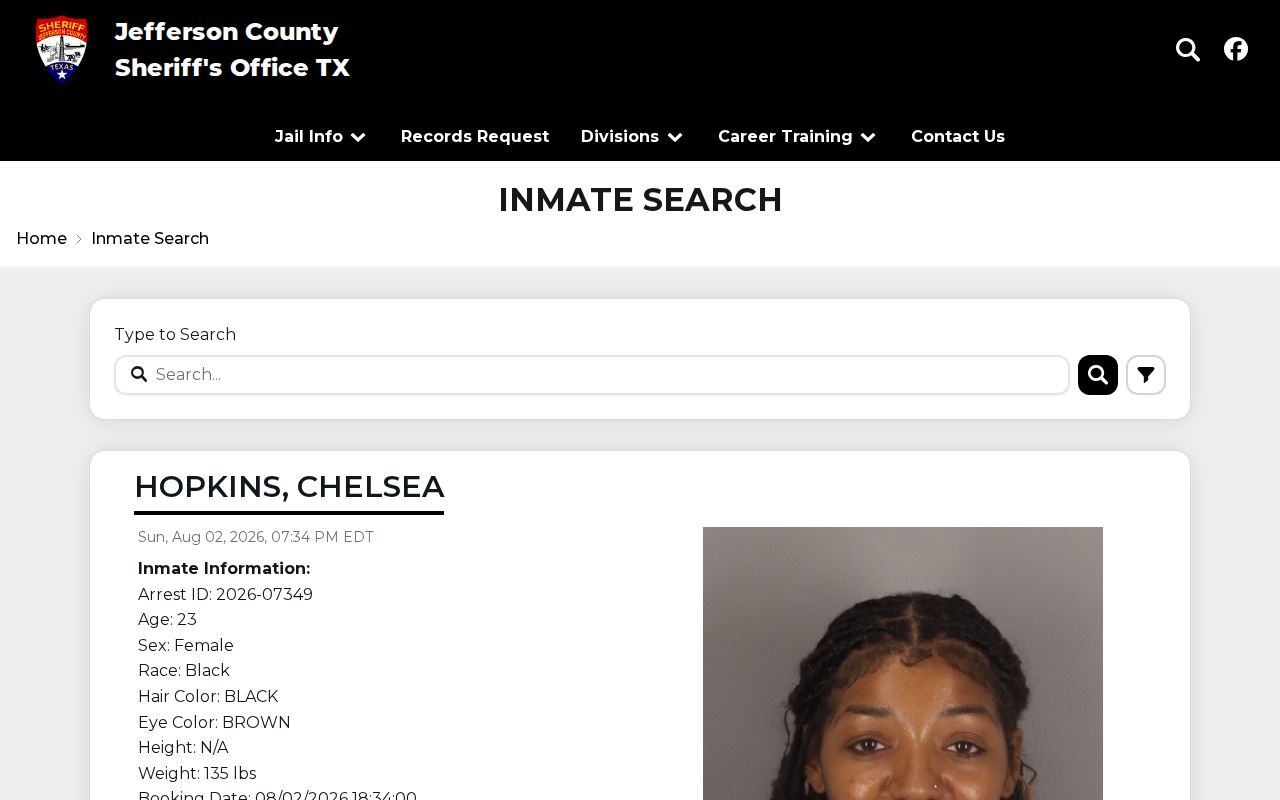
The screenshot documents the current-search design, not a 72-hour archive or release-retention rule.
If JCSO reports transfer to TDCJ, search the Texas Department of Criminal Justice after intake processing. A federal transfer belongs in federal records. A court order to release may still be delayed by another hold, so the signed order alone is not the physical departure record.
Jefferson County Three-Day Verification
A strong three-day result combines the jail ledger with the legal event that authorized departure. Start with the county record, inspect the relevant court case, and follow any transfer into the receiving system. Texas IVSS-Counties may provide a timely county notification, but an alert is not a certified release sheet. TDCJ IVSS is a separate lane for state prison and state supervision.
- Release
- The end of one custody segment, which may or may not lead to the community.
- Transfer
- Movement from Jefferson County custody to another agency or facility.
- Time served
- A sentence outcome crediting confinement already completed.
- Detainer
- A request or authority that may keep or move a person after another case changes.
Use Released Last 24 Hours when the question is limited to today. The 72-hour method is built for a broader calendar range and for days when updates or office schedules blur a same-day review.
Keep each Jefferson County departure tied to one booking. When names repeat, compare the booking number, age or birth date when public, cause number, arresting agency, and custody dates. A photograph alone cannot settle the match. If identifiers conflict, request the agency record rather than combining two histories.
A JCSO release sheet establishes the county event, but the receiving agency controls what happened next. Follow a TDCJ transfer into the state offender record after intake processing. Check a federal transfer through the applicable federal case or custody source. Another county must confirm its own custody. This preserves the vital difference between leaving the Jefferson County jail and leaving government custody altogether.
The court record supplies another check. A bond entry or dismissal may explain legal authority for one cause without proving physical checkout or resolving a second hold. Match the latest signed order to the jail movement time. If they do not align, ask JCSO whether processing, a detainer, or an agency transfer accounts for the difference.